Objects of Desire
Architecture as sculpture: Miró’s studio, Moneo’s star and Graves’ house
Sert’s studio for Miró, Moneo’s water-roofed gallery and Robert Graves’ house in Deià. No prices.

Which are Mallorca’s great houses? Not the ones in the estate agents’ windows. Joan Miró’s studio by Josep Lluís Sert, Rafael Moneo’s star-shaped gallery beside it and the house Robert Graves built in Deià are all open to visitors, and each answers the question of how an artist wants to live. Checked against the Fundació Miró Mallorca’s and the Fundació Robert Graves’ own pages in November 2026.
A studio by letter
Joan Miró settled in Mallorca in 1956 and got the studio he had dreamed of. His friend Josep Lluís Sert, a leading figure of the Modern Movement and then dean of Harvard’s Graduate School of Design, designed it; the two had met in the early 1930s, and they discussed the building by letter while it went up between 1954 and 1957. By the autumn of 1956 it was finished, and Miró, the foundation says, was enthusiastic.
The plan is an L on two levels under vaults, its rolling roofline giving movement to a regular frame. Reinforced concrete meets stone and clay, and the south front plays white concrete against blue, red and yellow woodwork. Miró asked for work and storage to be kept apart, and for a wall big enough for canvases such as his Cincinnati mural: a painter’s brief written in square metres.
Sert summed it up in one line: “L’arquitectura mateixa pot esdevenir una peça d’escultura”, architecture itself can become a piece of sculpture. On a hillside at Cala Major, it did.
A star with water on its roof
The second building came after Miró’s death. In 1986 his widow, Pilar Juncosa, gave land and 42 works to be sold at Sotheby’s for the foundation, and Rafael Moneo, who would win the Pritzker Prize in 1996, designed the result. It opened on 19 December 1992.
Moneo set two concrete volumes side by side: a long three-storey block for services, and a star-shaped gallery whose roof is covered in water, so that from above it reads as sea and horizon. Brise-soleils filter the light outside; inside, the walls are lined with translucent alabaster. A building that keeps a pond on its roof in a Mallorcan summer is either very confident or very well engineered, and here it is both.
It holds the galleries, a library, an auditorium, a shop and a café. Son Boter, the older house on the estate, is temporarily closed to the public for conservation work, so check before you plan around it.
A building that keeps a pond on its roof in a Mallorcan summer is either very confident or very well engineered.
A poet’s house in Deià
Robert Graves came to Deià in 1929 with the American poet Laura Riding, and the couple built Ca n’Alluny together. In 1936 they had to leave when the Spanish Civil War began; in 1946, after ten years away, Graves returned with his wife Beryl and their family, and lived in the house until his death in 1985. It opened to the public in the summer of 2006.

Photo Credit
Image courtesy of © Bärwinkel,Klaus · CC BY 4.0 via Wikimedia CommonsYou see the restored house, an exhibition hall, a fifteen-minute film on Graves and a garden laid out in the style of the 1930s; allow at least an hour, with description panels in every room and a guidebook at the ticket office.
Winter hours, from 1 November to 31 March, are Monday to Friday 9am to 4pm, last entry 3.20pm, and the house closes at weekends, on 8 December and from 9 December 2026 to 8 January 2027; on 4 December it opens only from noon.
A fortress turned house
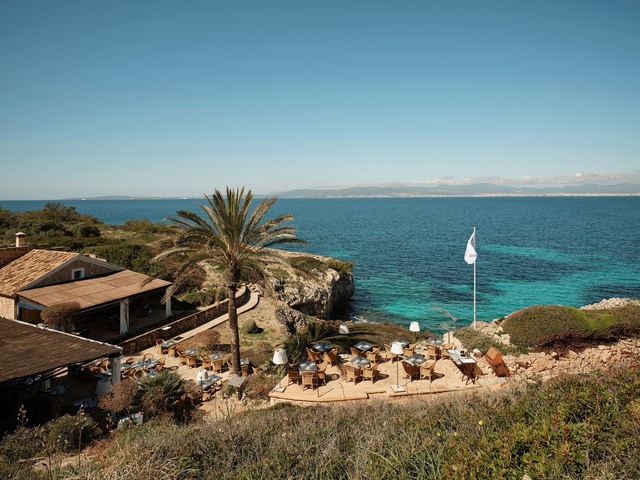
Mallorca’s boldest conversion is a fort. Cap Rocat, on the Bay of Palma, was raised to keep watch over the bay and, the hotel says, never performed the role it was built for. The studio of Antonio Obrador restored it for its present use, and the work won the Europa Nostra, España Nostra and Fortress Study Group awards. The building is a Bien de Interés Cultural and a National Monument, set in a protected natural area.

Photo Credit
Image courtesy of © Retogenes · CC BY-SA 4.0 via Wikimedia CommonsOur advice: see the Sert studio and the Moneo building on one morning at Cala Major, then drive the coast road to Deià on a weekday. Then book a table at Cap Rocat for the fort. Four buildings, one poet, and not a single price tag.
Why it's on our list
- A studio by letter
- A star with water on its roof
- A poet’s house in Deià
Location
The map comes from Google Maps, which sets its own cookies once it loads.
More in depth
 Objects of DesireAlmond, rum and candlelight: the Mai Tai, by the bookThe IBA’s Mai Tai, its almond secret and the Palma bars where the classics are mixed by hand.
 Objects of DesireLess parked than crouched: the electric Jaguar and the new supercarsJaguar’s Type 00 and Type 01, Ferrari’s first electric car and the record-breakers around them.
 Objects of DesireWood, iron and a barrier at kilometre 2: Mallorca’s beautiful machinesThe 1912 wooden train, the 1913 tram, Formentor’s barriers and the marinas where the yachts wait.