Objects of Desire
Wood, iron and a barrier at kilometre 2: Mallorca’s beautiful machines
The 1912 wooden train, the 1913 tram, Formentor’s barriers and the marinas where the yachts wait.

Photo Credit
Image courtesy of © Kritzolina · CC BY-SA 4.0 via Wikimedia CommonsWhat is the most desirable machine on Mallorca? Not the yacht, though Puerto Portals takes them up to 60 metres. It is a wooden train of 1912 that runs through a 2,856-metre tunnel to reach Sóller. Here is the island’s motoring in four objects: the train, its tram, the Formentor road and the marinas, checked against the operators’ and the DGT’s own pages in November 2026.
Through the mountain
Sóller had orange groves, a thriving industry and a problem: the mountains, which cut it off from Palma. The railway was built to end that isolation. Work began on 3 June 1907, a tunnel of 2,856 metres was driven through the Serra d’Alfàbia, and after an unofficial run on 7 October 1911 the line opened officially on 16 April 1912, behind locomotives named Sóller and Palma.
The first six carriages came from Carde & Escoriaza in 1912, with locomotives from La Maquinista Terrestre y Marítima. On 14 July 1929 electric traction arrived between Palma and Sóller, and in 1930 direct tourist services to the port began, with four motor cars of 33 tonnes and 360 horsepower apiece. It is the rare commuter line that people now ride for the woodwork.
In August 1913 a fourth locomotive, Son Sardina, joined the first two, and four more carriages from the original order arrived the same year. The engines carry place names, Sóller, Palma and Son Sardina, which for a railway built to join places is exactly the point.
The tram that carried fish
On 4 October 1913 Mallorca’s first electric tram opened between Sóller and its port, on 4,868 metres of track, with an iron bridge over the Torrent Major. Its power came from a 65-horsepower engine driving a 600-volt Siemens-Schuckert dynamo, and it carried fresh fish, coal and military supplies as well as passengers.
Three motor cars and two trailers are still the originals of 1913. Open cars came from Palma in 1954, and five motor cars from Lisbon were adapted to the 914 mm gauge: a line that has collected trams the way the port collects yachts. This winter the train rests from 23 November 2026 to 1 February 2027, and the tram from 23 November to 22 December, with a bus in its place.
Formentor, by permission
The island’s most famous drive now comes with a barrier. From 15 May to 18 October, 10am to 10pm, the DGT restricts the Ma-2210 to Cap de Formentor between kilometre points 2.0 and 19.6. A barrier at kilometre 2 lets private cars reach the Formentor beach car park while there is space; a second, at kilometre 8.7, admits only authorised vehicles to the lighthouse road.

Photo Credit
Image courtesy of © Marc Ryckaert (MJJR) · CC BY 3.0 via Wikimedia CommonsResidents, drivers of vehicles for people with reduced mobility and other authorised users must write to the DGT at least three working days ahead; the barrier then reads their number plate or a QR code. Coaches, taxis and VTC cars may use the beach section, but the lighthouse road is left to the shuttle, residents, bicycles and the emergency services.
It is the rare commuter line that people now ride for the woodwork.
The TIB’s line 334 runs from Alcúdia and Port de Pollença to the lighthouse, and drivers who go in before the barriers start must be past kilometre 8.6 by 9.58am to avoid a fine. Even one wheel on the asphalt where parking is not marked is sanctioned. Outside those dates the road is open, which makes November the month it belongs to drivers again.
Marinas and a Porsche
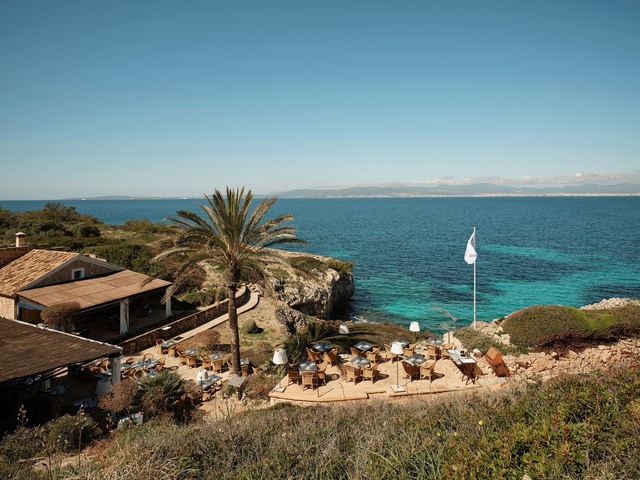
The yachts have their own grand avenues. Puerto Portals takes vessels from 8 to 60 metres; Port Adriano at El Toro calls itself the marina designed by Philippe Starck; Club de Mar and the Real Club Náutico de Palma hold the city’s quays, with regattas through the year. For four wheels, Centre Porsche Balears is the official Porsche centre in Palma, on the Camí dels Reis, with test drives booked through Porsche’s dealer search.

Photo Credit
Image courtesy of © Thomas Wolf, www.foto-tw.de · CC BY-SA 3.0 de via Wikimedia CommonsIn winter the quays keep their own season. Puerto Portals lights its Christmas market on 11 December 2026 and keeps it open until 6 January, and Port Adriano sets up its own Christmas park on the quay, the only time of year the yachts are upstaged by fairy lights.
Our advice: ride the Sóller train when it returns in February, drive Formentor early on a winter morning, and walk the marinas out of season, when the yachts are at rest and you can read the names on the sterns in peace.
Why it's on our list
- Through the mountain
- The tram that carried fish
- Formentor, by permission
Location
The map comes from Google Maps, which sets its own cookies once it loads.
More in depth
 Objects of DesireA palace for a prince’s lungs: Chopin, Händel and Mallorca’s music roomsChopin at the Cartoixa, the island orchestra’s December and the Auditòrium on Palma’s bay.
 Objects of DesireArchitecture as sculpture: Miró’s studio, Moneo’s star and Graves’ houseSert’s studio for Miró, Moneo’s water-roofed gallery and Robert Graves’ house in Deià. No prices.
 Objects of DesireAlmond, rum and candlelight: the Mai Tai, by the bookThe IBA’s Mai Tai, its almond secret and the Palma bars where the classics are mixed by hand.